Pizza
Neapolitan vs Roman pizza: what's the difference
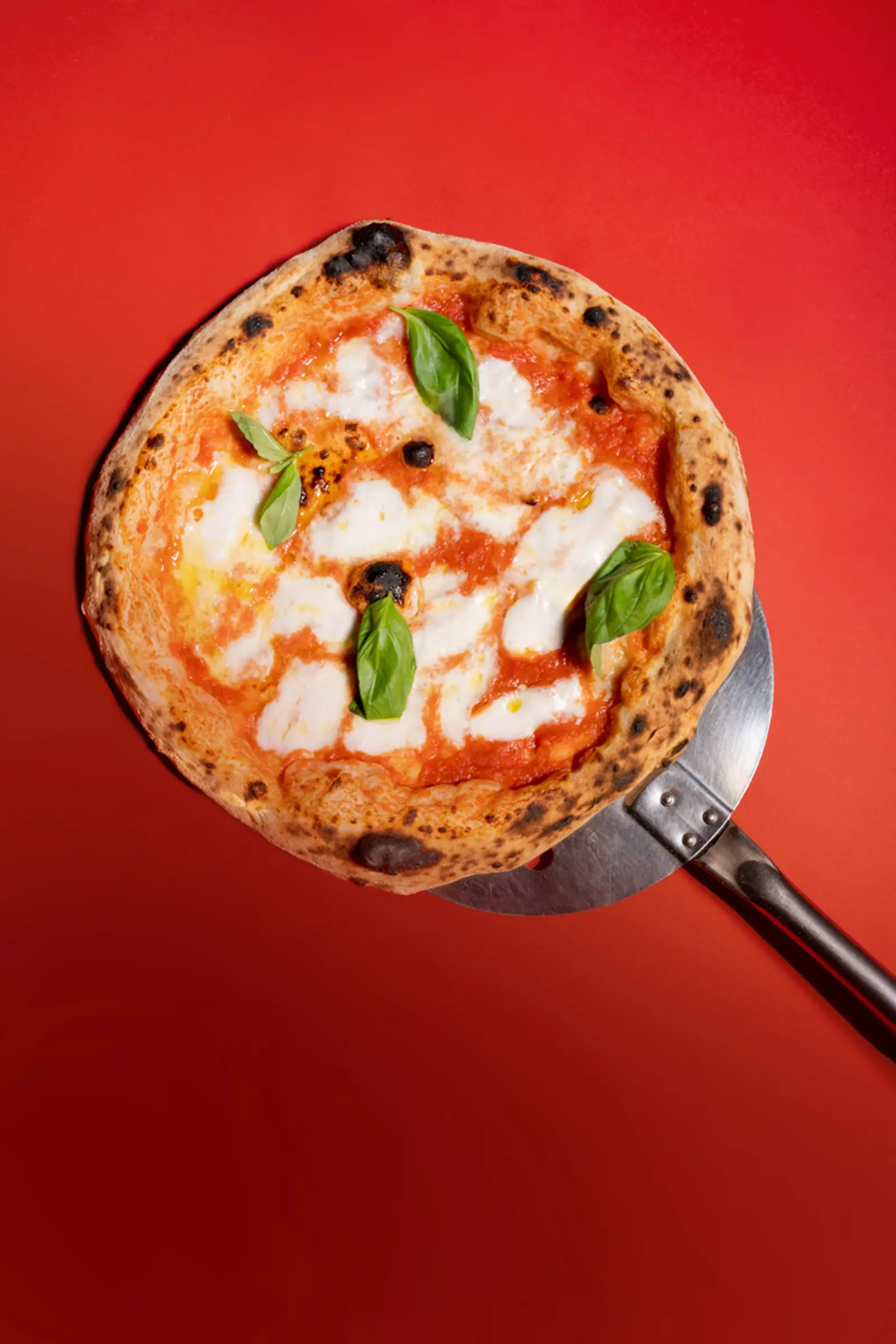

Pizza
Roman pizza, the tonda romana, is thin and crisp with a flat rim, and bakes for longer in a cooler oven. Neapolitan pizza has a soft centre and a risen, puffy rim, and bakes for about a minute in a very hot oven. At Bottegas in Warsaw we bake Neapolitan pizza in the contemporanea style, in an oven at 485°C.
In Italy, pizza isn't one dish. Naples, where pizza was born, bakes it soft with a risen rim. Rome has styles of its own: a thin, crisp round pizza called tonda romana or “scrocchiarella”, and pizza al taglio, baked in trays and sold by the slice.
Both are real Italian pizza. They differ in dough, shaping, oven and baking time — in other words, in everything that decides what you taste.
Neapolitan dough has four ingredients: flour, water, salt and yeast. It's stretched by hand, from the centre outwards, so the air stays in the rim. That's why the cornicione rises light and airy in the oven.
Roman pizza dough often has olive oil in it, and the base is rolled or stretched very thin, right to the edge. There's no puffy cornicione: the whole pizza is roughly the same thickness.
Our dough is at 80% hydration and matures for 48 hours. That's a very wet dough, typical of pizza contemporanea. We explain it in our piece on pizza contemporanea vs classic Neapolitan.
Neapolitan pizza bakes in a very hot oven, very quickly — usually 60 to 90 seconds. Our oven runs at 485°C and the pizza spends a little over a minute inside. The base chars, the centre stays soft.
Roman pizza bakes at a lower temperature for longer, usually a few minutes. In that time it loses moisture and turns crisp from edge to centre. It's easy to cut and eat with your hands.
Neapolitan: a soft, moist centre, a puffy rim and a clear flavour of matured dough. You eat it with a knife and fork, or fold it — in Naples they call that a portafoglio.
Roman: thin, crisp, lighter in the hand, with a flat rim. It's closer to a thin, crumbly flatbread than to bread.
Which is better? Italians can argue about that for a whole dinner. In truth they're two different pizzas, and each has its moment.
On Rome's streets, pizza al taglio is everywhere. It's baked in rectangular trays, cut into pieces and sold by weight. The dough is thicker and open, the base crisp.
It's Rome's snack on the move, just as in Naples it's a pizza folded in four and wrapped in paper.
At Bottegas we bake Neapolitan pizza in the contemporanea style. Two of our three founders, Antonio and Roberto, are from Naples, so for us this is the pizza of home. The third, Matteo, is from Tuscany.
We use San Marzano DOP tomatoes, and on the Antica Napoli the mozzarella di bufala campana DOP goes on after baking. The menu has nine pizze rosse, six bianche and two calzoni, from 39 to 69 zł, the same at Bottegas Śródmieście and Bottegas Saska Kępa. The full list is on our page about Neapolitan pizza in Warsaw.
And if it's Rome you're after, we'd point you to the pasta: carbonara with no cream, made the Roman way, costs 59 zł.
Roman pizza is thin and crisp with a flat rim, and bakes for a few minutes in a cooler oven. Neapolitan pizza has a soft centre and a risen, puffy rim, and bakes for about a minute in a very hot oven.
In the centre, yes, but the rim is risen and puffy. The pizza that's thin and crisp all over is Roman.
Roman pizza baked in rectangular trays, cut into pieces and sold by weight.
No. At both restaurants we bake Neapolitan pizza in the contemporanea style, in an oven at 485°C.
We use cookies for statistics (Google Analytics) and marketing (Meta, TikTok, Google Ads). Consent is optional and you can change it at any time. Privacy policy