Pizza
What is pizza contemporanea? vs classic Neapolitan pizza

Pizza
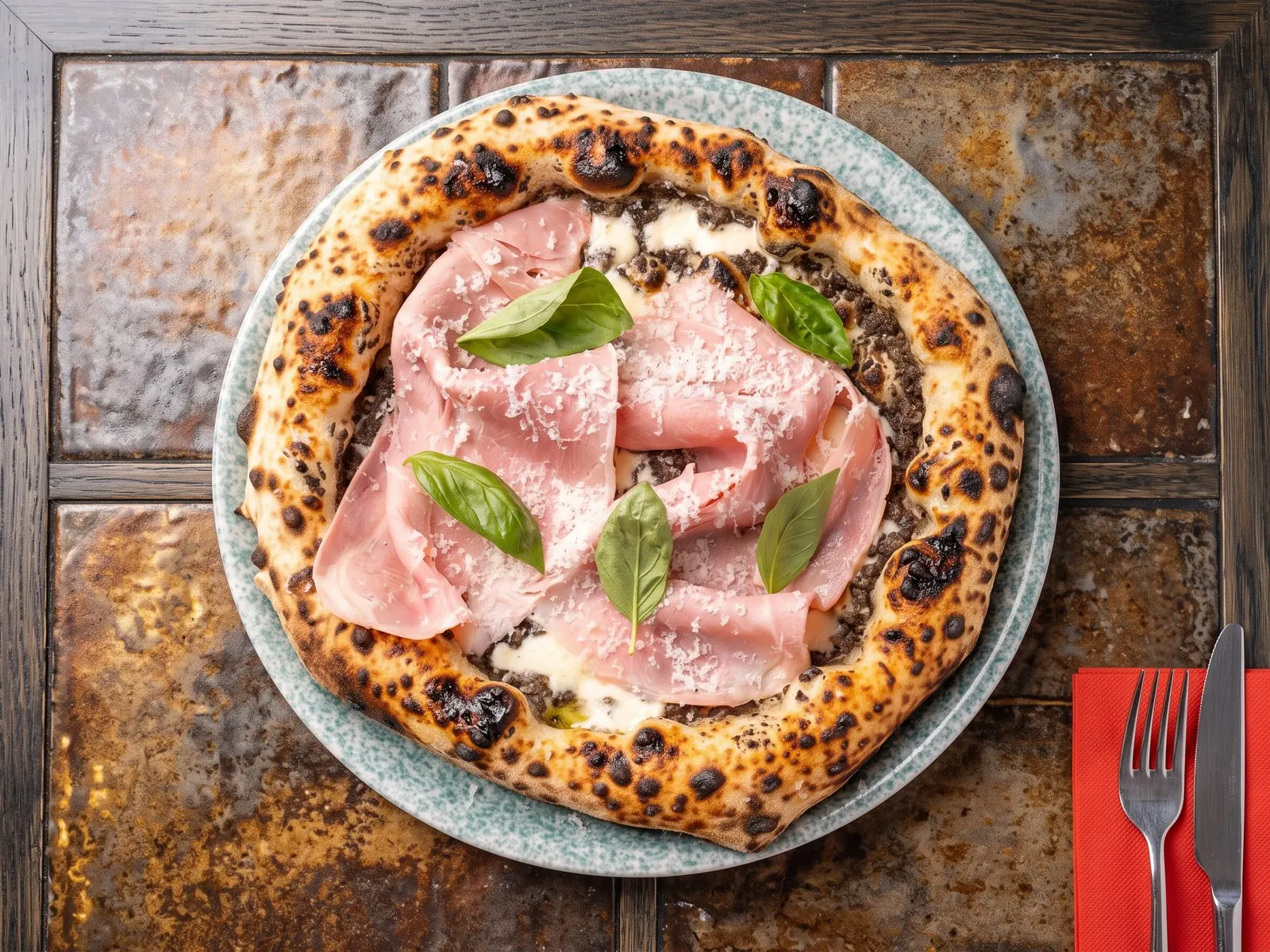
Pizza contemporanea is a modern style of Neapolitan pizza. It has the same base as the classic — flour, water, salt, yeast, a very hot oven and a short bake — but the dough is wetter and matures for longer, so the crust (the cornicione) is taller, lighter and full of air. At Bottegas in Warsaw we make it with an 80%-hydration dough matured for 48 hours and bake it at 485°C.
Classic Neapolitan pizza has a low, elastic rim and a soft, thin centre. It's supple enough that in Naples people fold it “a portafoglio” — in half and then in half again, like a wallet — and eat it standing up, straight from the paper. It's street food and everyday food, made that way for generations.
Pizza contemporanea keeps the same soft centre, but the rim is clearly taller, puffier and full of large air pockets. Italians jokingly call the most inflated version “canotto” — a rubber dinghy. The point, though, isn't to make the rim as big as possible. The point is to make it light: crisp on the outside, soft and open inside.
It isn't a different pizza, just the same tradition in a newer form. Flour, water, salt and yeast, a very hot oven, a bake that takes moments — none of that changes. So if you're asking how pizza contemporanea differs from Neapolitan pizza, the short answer is the crust, and the crust depends on two things: how much water goes into the dough, and how much time the dough is given.
Hydration is simply the ratio of water to flour. Our dough is at 80% hydration: 800 grams of water for every kilo of flour. That's a lot — the dough is soft, sticky and needs practised hands. In the oven the water turns to steam, the steam pushes the dough out from the inside, and that's where the big air pockets in the rim come from.
Maturation is the time the dough spends before it goes into the oven. Ours gets 48 hours. During that time yeast and enzymes work slowly and break down part of the starch and gluten. The dough gains flavour, becomes more extensible and rises better in the oven. That's why this dough can't be made “for today” — the pizza you're eating was started two days earlier.
We bake at 485°C. At that temperature a pizza is ready in a little over a minute. In that time the rim rises, chars in dark spots and traps the air inside, while the centre stays soft and moist. The tomato has no time to cook down, so it still tastes of tomato, and the mozzarella melts without drying out.
The short bake is the heart of Neapolitan pizza. In a cooler oven the dough would take longer, dry out and turn hard. Here everything happens fast, so the pizza is charred and soft at the same time — which is exactly what we're after.
A tall rim looks substantial, but much of it is air. The long maturation breaks down part of the starch and gluten, which is why pizza contemporanea is lighter and easier to digest than it looks. A good Neapolitan pizza shouldn't leave you feeling heavy.
Lighter doesn't mean gluten-free. If you can't eat gluten, we'll make any pizza on the menu with gluten-free dough for 20 zł extra. The Vegan Capricciosa is fully vegan, and several other pizzas are vegetarian.
Start from the centre. It's the softest, wettest part of the pizza, where most of the tomato and cheese sits. A knife and fork for the first few bites is perfectly fine — people in Naples do the same when the pizza is fresh from the oven.
Then use your hands. Pick up a slice and fold it slightly lengthways so the tip doesn't droop. Leave the rim for last: it's crisp outside and soft inside, and the last piece is for wiping up what's left of the tomato and oil on the plate. Italians have a word for that — “scarpetta”.
And eat it straight away. The first minutes out of the oven are the best moment of any pizza — don't wait politely until everyone at the table has theirs.
A modern dough doesn't change one thing: a pizza is only as good as what goes on it. We use San Marzano DOP tomatoes, mozzarella di bufala campana DOP, fior di latte, parmigiano DOP, Prosciutto di Parma DOP aged 24 months, Calabrian 'nduja, friarielli and extra virgin olive oil.
On the Antica Napoli we add the bufala only after baking, the way Naples did it before passata and fior di latte became the norm. The cheese stays fresh, cool and milky on the hot dough. We explain why that matters in our piece on mozzarella di bufala campana DOP.
On your first visit, order the Margherita (39 zł): San Marzano DOP, mozzarella, grana padano, basil. It shows the dough best. Then the Antica Napoli (55 zł), to taste the difference bufala makes when it goes on after the bake.
If you like heat: the Diavola (49 zł) or the Vibrant Vesuvio with 'nduja and stracciatella (55 zł). If you'd rather skip the tomato, go for the pizze bianche — Mortadella with pistachios (55 zł), Salsiccia e Friarielli (59 zł) or, in winter, the Pere e Gorgonzola with pear, Gorgonzola DOP and walnuts (57 zł). Every price and ingredient is in the full Bottegas Śródmieście menu; in Saska Kępa the pizzas and prices are the same.
Pizza contemporanea is at its best in the first few minutes. After that, steam from the hot centre starts to soften the base and the rim loses its crunch. That's why our pizza goes from the oven straight to the table and never waits.
If you're ordering takeaway or delivery, open the box as soon as it arrives and eat it while it's warm. There's more on how we make Neapolitan pizza in Warsaw on its own page. If you're comparing styles, read how Neapolitan pizza differs from Roman and how to spot a good Neapolitan pizza.
Yes. It's a modern style of Neapolitan pizza: the same base (flour, water, salt, yeast), a very hot oven and a short bake. The difference is a taller, lighter rim, which comes from wetter dough and longer maturation.
Because the dough is at 80% hydration and matures for 48 hours. At 485°C the water in the dough turns to steam and puffs up the rim, creating large air pockets.
It's lighter than it looks. The long maturation breaks down part of the starch and gluten, so the dough is easier to digest, and the tall rim is largely air.
Yes. Any pizza on the menu can be made with gluten-free dough for 20 zł extra.
At Bottegas: ul. Oboźna 9 in Śródmieście and ul. Francuska 24 in Saska Kępa. The pizza menu and prices are the same at both, from 39 zł for a Margherita.
We use cookies for statistics (Google Analytics) and marketing (Meta, TikTok, Google Ads). Consent is optional and you can change it at any time. Privacy policy