Kitchen
Authentic Carbonara with No Cream: the Roman Way

Kitchen
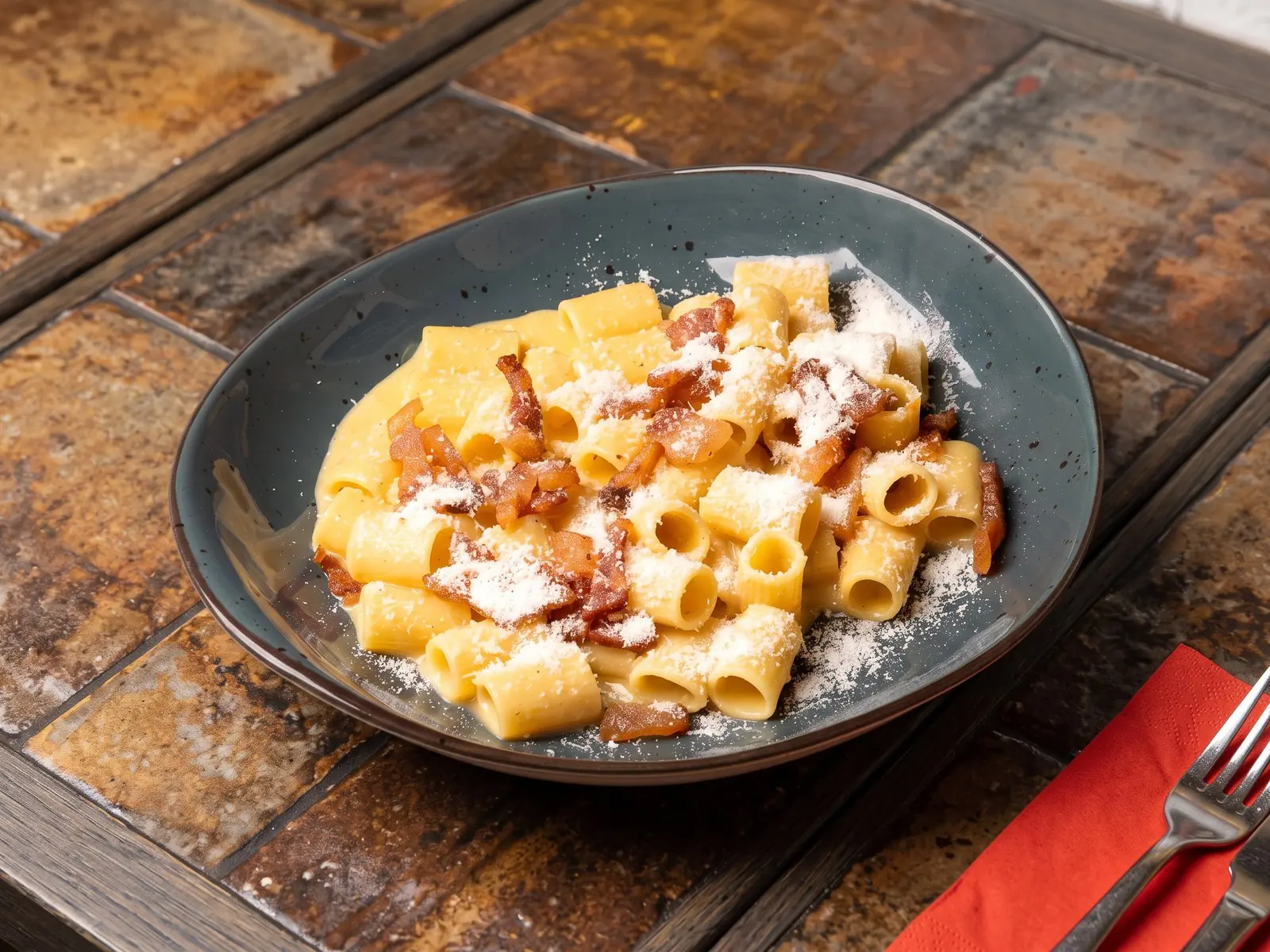
Authentic carbonara is a Roman dish of five ingredients: pasta, guanciale, egg yolk, pecorino romano and black pepper – no cream, no garlic, no onion. The creaminess comes from an emulsion of yolks, cheese, guanciale fat and starchy pasta water, brought together off the heat. At Bottegas in Warsaw we serve Rigatoni Carbonara for 59 zł, or 69 zł with truffle.
Carbonara is one of the four classic Roman pasta dishes, alongside cacio e pepe, gricia and amatriciana. Pecorino romano and pepper run through all of them. Carbonara adds guanciale and egg.
The list is short: pasta, guanciale, egg yolks, pecorino romano, freshly ground black pepper. The sixth, invisible ingredient is the pasta cooking water. There is no cream, butter, olive oil, garlic, onion or parsley.
Where does the name come from? There are several stories and none of them is certain, so we'll leave them to the historians. One thing is sure: it is a Roman dish, and Rome decided how it should taste.
A short list doesn't make it an easy dish. With so few ingredients, each one has to be good, and technique decides everything. The difference between a silky sauce and pasta with scrambled egg is a matter of seconds and pan temperature.
Guanciale is cured pork cheek, rubbed with salt and pepper and aged for several weeks. It is not smoked. It has more fat than meat, and that fat, once rendered, is sweetish, clean-tasting and makes up half of the sauce.
Pancetta is cured belly – a decent substitute, but leaner and less aromatic. Smoked bacon changes the dish completely: the smoke covers the cheese and the pepper. It can taste good, but it is no longer a Roman carbonara.
We cut guanciale into strips or small cubes and render it slowly in a dry pan. It should be golden and crisp outside, still tender inside.
Yolks give the sauce its colour, body and silky texture. Some cooks add one whole egg for several portions to lighten it. White alone thins the sauce and sets faster, which is why we rely on the yolk.
Pecorino romano DOP is a hard sheep's milk cheese: salty, sharp, assertive. Some people mix it with parmigiano to soften it, but the Roman base is pecorino. Grate it very finely or it will clump.
Grind the pepper coarsely, just before using it, ideally toasting it briefly in the pan. It is not a garnish – it is one of the dish's main flavours.
Carbonara's creaminess doesn't come from cream, it comes from an emulsion. Yolks, grated cheese, guanciale fat and starchy pasta water come together into a smooth, glossy sauce that coats every piece of pasta.
Cream is a shortcut: it protects against scrambling, but it dilutes the pecorino and pepper, and the dish becomes heavy and flat. Instead, one rule is enough – combine the eggs with the pasta off the heat.
A well-made carbonara is lighter than it looks. It tastes of egg, cheese and pepper, not of dairy.
In Rome, both choices are correct. Spaghetti is the version best known around the world. Rigatoni and mezze maniche are just as much a classic of Roman trattorias.
We choose rigatoni. The ridged surface holds the sauce, and a little more stays inside each tube. Pieces of guanciale slip inside, so every bite has everything at once.
At home, choose bronze-die pasta – its rough surface holds the sauce better than a smooth one.
Per person: about 100 g of pasta, 40 g of guanciale, 2 egg yolks, 25–30 g of finely grated pecorino romano and plenty of freshly ground pepper. Salt the pasta water lightly – guanciale and pecorino are already salty.
Render the guanciale slowly, starting in a cold pan with no added fat. In a bowl, mix the yolks, pecorino and pepper into a thick paste, and while the pasta cooks, loosen it with a spoonful of hot water from the pot.
Drain the pasta al dente, keeping a cup of the water. Tip it into the pan with the guanciale, toss it in the fat and take the pan off the heat. Wait a moment, add the egg mixture and toss hard, adding pasta water little by little, until the sauce is smooth and glossy.
If the sauce is too thin, keep tossing – it will thicken. If it turns lumpy, the pan was too hot; next time wait longer. Serve straight away, with more pepper and a little pecorino on top.
The most common mistakes: cream “just in case”, garlic in the pan, ready-grated cheese from a bag that clumps, and too little pasta water. And one more: carbonara doesn't wait. After a few minutes on the table it thickens and loses its gloss.
Our Rigatoni Carbonara costs 59 zł: guanciale, egg yolk, pecorino romano DOP, black pepper – no cream, as in Rome. The truffle version is 69 zł. For a gluten-free option we serve it on gluten-free penne (+6 zł).
Its closest relative is Gnocchi Cacio e Pepe at 51 zł: potato gnocchi, pecorino romano DOP, black pepper and cooking water. The same emulsion technique, just without egg and guanciale. If you like carbonara, try its cleaner, sharper sibling.
You'll find both on the Bottegas Śródmieście menu and the Saska Kępa menu – the kitchen and prices are the same at both restaurants. Read more about what we cook beyond pizza on our page about Italian food in Warsaw. Rome has its own pizza too — we explain how Roman pizza differs from Neapolitan separately.
No. Roman carbonara has no cream. The creamy sauce comes from yolks, pecorino romano, guanciale fat and pasta water, combined off the heat.
The closest substitute is unsmoked pancetta. Smoked bacon changes the dish, because the smoke dominates the cheese and pepper.
Yolks are the base – they make a thick, silky sauce. Some cooks add one whole egg for several portions. At Bottegas we use yolk.
The pan was too hot. Take it off the heat before adding the egg mixture, wait a moment and toss hard, adding pasta water.
Rigatoni Carbonara costs 59 zł, or 69 zł with truffle. Prices are the same at Oboźna 9 and Francuska 24.
Yes. We can serve the carbonara on gluten-free penne, for an extra 6 zł.
We use cookies for statistics (Google Analytics) and marketing (Meta, TikTok, Google Ads). Consent is optional and you can change it at any time. Privacy policy